
.webp&w=256&q=75)
Dwarka Expressway Properties: Complete Buyer & Investment Guide 2026
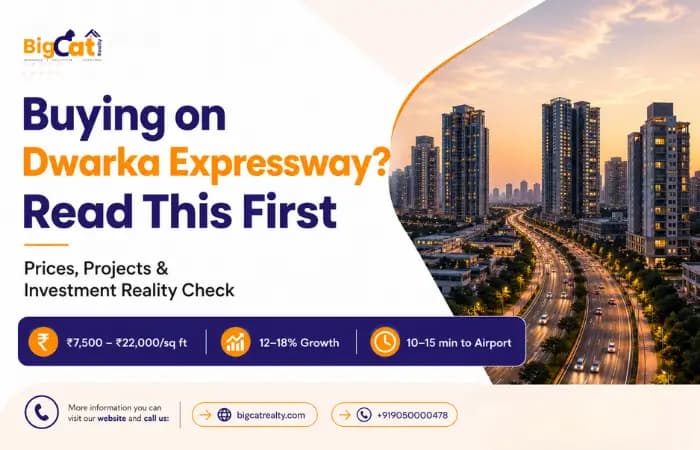
Dwarka Expressway properties have crossed the speculation phase. The expressway is open. Metro work is progressing. Schools, hospitals, and retail are functional in several sectors. If you are evaluating this corridor in 2026, you are not buying a promise. You are buying into infrastructure that is already working.
That said, not every project here is worth your money. Prices vary sharply by sector. Developer credibility matters. And documentation on some plots still carries legacy risks. This guide breaks all of that down so you can move forward with clarity.
Why This Corridor Matters Right Now
Dwarka Expressway connects Dwarka in Delhi to Gurgaon Sector 88 across 29 kilometres. For years, the incomplete flyovers and delayed projects kept serious buyers away. That changed after 2023. Full operationalisation of the expressway shifted buyer sentiment decisively.
Today, the corridor appeals to three distinct groups. End-users want Delhi proximity without Delhi prices. Investors want appreciation potential that central Gurgaon no longer offers at these entry points. NRI buyers want large-format branded apartments with managed amenities. All three groups are active right now.
Quick market snapshot:
Expressway fully operational, connecting Dwarka to NH-48 without signals
IGI Airport reachable in 10 to 15 minutes from most sectors
Blue-chip developers active: DLF, Godrej, M3M, Sobha, Central Park
Price gap vs Golf Course Extension still 15 to 25 percent, creating upside room
End-user demand strongest in the Rs 1.5 crore to Rs 4 crore bracket
Factor | Current Status | What It Means for Buyers |
Expressway | Fully operational | No infrastructure bet needed |
Metro | Planned extension in progress | Future connectivity upside |
Developer Profile | DLF, Godrej, M3M, Sobha | Brand assurance on delivery |
Price Range | Rs 7,000 to Rs 22,000 per sq ft | Options across all budgets |
Airport Distance | 10 to 15 minutes | Strong draw for transit buyers |
Dwarka Expressway Property Price Guide by Sector
Pricing on this corridor is not uniform. Sector location, developer brand, and possession status all drive significant variation. Here is how the numbers look in 2026.
Residential Pricing
Mid-segment projects in Sectors 99 to 103 are priced between Rs 7,500 and Rs 11,500 per sq ft. These are largely near-completion or ready-to-move units. Premium towers in Sectors 105 to 113 from DLF, Godrej, and M3M range from Rs 14,000 to Rs 22,000 per sq ft. New launch projects on Dwarka Expressway are entering at Rs 12,000 to Rs 16,000 per sq ft at introductory stages.
Year-on-year appreciation across the corridor has run at 12 to 18 percent over the past two years. That is ahead of most established Gurgaon micro-markets for the same period.
Commercial Property on Dwarka Expressway
Commercial property here targets mid-size businesses serving the growing resident population. Office spaces and high-street retail on the expressway link road are priced at Rs 8,000 to Rs 18,000 per sq ft. Rental yields on commercial units run between 6 and 9 percent. That compares well against residential yields of 2.5 to 4 percent in the same area.
Segment | Price per Sq Ft (Rs) | Rental Yield | Outlook |
Sectors 99 to 103 (Mid) | 7,500 to 11,500 | 2.5% to 3.5% | Stable |
Sectors 105 to 113 (Premium) | 14,000 to 22,000 | 3% to 4% | Strong |
Commercial Link Road | 8,000 to 14,000 | 6% to 8% | Moderate to High |
Township Retail | 10,000 to 18,000 | 7% to 9% | High as density rises |
New Launch Projects | 12,000 to 16,000 | To be established | Watch developer track record |
Is Dwarka Expressway Real Estate Investment Worth It in 2026?
The investment case rests on three things: price gap vs peer markets, rental demand growth, and infrastructure-led appreciation that has not yet peaked.
Appreciation Potential
Golf Course Extension and Southern Peripheral Road have already seen sharp price runs. Dwarka Expressway still trades at a 15 to 25 percent discount to comparable product there. As occupancy in completed projects rises and social infrastructure deepens, that gap will narrow. This convergence pattern has played out on every major Gurgaon corridor before this one.
Rental Yield and ROI
A 3 BHK bought at Rs 1.8 crore in Sector 103 today rents for Rs 35,000 to Rs 45,000 per month. That gives a gross yield of roughly 2.3 to 3 percent. It is not high on its own. But combine that rental income with price appreciation, and the blended IRR over a 5-year hold has historically ranged from 10 to 15 percent on well-selected Dwarka Expressway projects.
Home Loan Rates
Loan rates currently sit between 8.5 and 9.25 percent for salaried borrowers. Any rate reduction cycle in late 2025 or 2026 will improve affordability for end-users. For investors, rental income partially offsets EMI outflows on properties in the Rs 1.2 to Rs 2.5 crore range, making leverage manageable.
Legal and Documentation Checks You Cannot Skip
RERA Compliance
Every project launched after May 2017 must be registered under HRERA. Check the registration number at hrera.org.in before signing anything. The portal shows approved plans, completion timelines, and any regulatory proceedings. A project missing from the portal is a hard stop.
Title Verification
Land title on parts of this corridor has a complicated history. Some sectors had disputes between HUDA and private landowners. Before buying, get an independent title search from a registered advocate covering the last 30 years. Confirm there is no pending litigation at any revenue or civil court.
Agreement and Registration
For under-construction projects, the Builder Buyer Agreement must spell out construction milestones, delayed possession penalties, and cancellation refund terms. For resale, a Sale Deed registered at the Gurgaon Sub-Registrar office is mandatory. Stamp duty in Haryana is 7 percent for male buyers and 5 percent for female buyers, with 0.5 percent registration charges on the deal value.
What Smart Buyers Do Before Committing
Check RERA yourself. Do not rely on the developer's brochure. Cross-verify on hrera.org.in.
Visit at peak and off-peak hours. Traffic on the Dwarka Expressway link road behaves very differently at 9 AM vs 11 AM.
Calculate carpet area, not super area. A 1,800 sq ft super area flat may have only 1,200 to 1,350 sq ft of usable space under RERA definitions.
Add all costs before comparing. Parking, PLC, club membership, GST, and stamp duty can add 15 to 20 percent on top of the base price.
Check occupancy levels in the project. High vacancy in completed towers signals maintenance or social infrastructure problems.
Review developer financials on RERA. Projects where large payment tranches are drawn without matching construction progress carry real financial risks.
Why Location Within the Corridor Matters
Sectors 99 to 105 appeal to buyers who need Delhi proximity. These sectors border Dwarka directly and offer shorter commutes to government offices, diplomatic enclaves, and South Delhi institutions. End-user demand here is high and possession-ready inventory moves fast.
Sectors 108 to 115 attract IT sector professionals and investors. Projects here are larger in scale, amenity-heavy, and carry stronger long-term appreciation potential. The trade-off is a slightly longer commute to central Delhi.
Final Word
Dwarka Expressway properties in 2026 are not a bet. The infrastructure is real. The developers are credible. The demand is measurable. What remains uncertain is the specific project you choose.
That decision requires verifying RERA status, checking title, reading the agreement carefully, and calculating the full cost of ownership. Buyers who do this work find good assets at fair prices. Those who skip it often regret it.
BigCat Realty works with buyers and investors on this corridor with an advisory approach grounded in data and independent assessment. The goal is not to push a project. It is to help you find the right one for your situation.
Frequently Asked Questions
1. What is the property price range on Dwarka Expressway in 2026?
Prices range from Rs 7,500 per sq ft in mid-segment sectors like 99 to 103, up to Rs 22,000 per sq ft for luxury towers in Sectors 108 to 115. New launch projects are typically entering at Rs 12,000 to Rs 16,000 per sq ft.
2. Is Dwarka Expressway a good real estate investment right now?
Yes, for buyers with a 3 to 5 year horizon. The corridor still trades at a discount to Golf Course Extension, rental demand is growing, and blended returns have averaged 10 to 15 percent IRR on well-chosen projects over five-year holds.
3. Which sectors on Dwarka Expressway are best for end-users vs investors?
Sectors 99 to 105 suit end-users who need Delhi proximity. Sectors 108 to 115 suit investors who want larger projects, better amenities, and stronger long-term appreciation.
4. What documents should I check before buying on Dwarka Expressway?
Verify the RERA registration on hrera.org.in, get a 30-year title search done independently, review the Builder Buyer Agreement clause by clause, and confirm there is no litigation on the land.
5. How does commercial property on Dwarka Expressway compare for investment?
Commercial units offer 6 to 9 percent rental yield against 2.5 to 4 percent for residential. The entry cost is higher and vacancy risk is real during the stabilisation period, but income potential is stronger for investors comfortable with commercial leasing.
Tags:dwarka expressway propertiesdwarka expressway property pricecommercial property
.webp&w=384&q=75)